
From periphery to prosperity: Linking Cagsao and Itangon to the tourism mainstream
By Mariel R. Estrella, PhD
Camarines Sur’s coastal villages—Cagsao in Calabanga and Itangon in Bula—are living testaments to the harmony of nature and culture. Black-pebbled beaches, coral reefs, mangrove forests, tidal caves, and vibrant fiestas make them destinations of rare beauty. Yet, despite their richness, these communities remain peripheral—remote and disconnected from the mainstream tourism market.
This proposition reframes this challenge into opportunity: link these peripheral gems to a central tourism hub, and both communities and investors stand to gain. The concept is rooted in spatial hierarchy theory, which explains how peripheral sites can be strategically connected to hubs through a layered system of gateways—national, regional, and local.
Theoretical Foundations: Spatial Hierarchy in Tourism
Tourism scholars such as Pearce (2002) and Zurick (1992) emphasize that core-periphery relationships define how destinations thrive. Peripheral areas, while rich in natural and cultural assets, often lack infrastructure and visibility. By linking them to hubs through a hierarchical gateway model, they gain access to tourist flows, investment, and markets.
• National Gateways: Metropolitan centers act as entry points for international and domestic tourists.
• Regional Gateways: Cities like Naga serve as staging areas, channeling visitors toward peripheral destinations.
• Local Gateways: Towns and barangays provide direct access, offering themed itineraries, transport connectivity, and community-based tourism experiences.
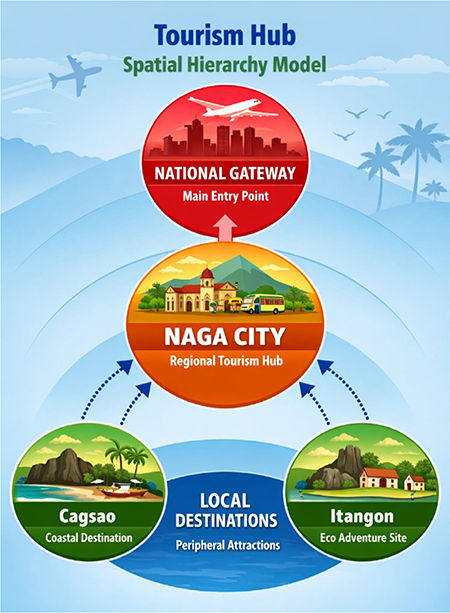
This layered model ensures that peripheries like Cagsao and Itangon are not isolated attractions but integral parts of a tourism circuit. Connectivity is both structural (roads, transport, digital promotion) and attributes-based (unique natural and cultural features).
Why It Matters for Business and LGUs
For business groups, the spatial hierarchy model translates into predictable flows of tourists—a foundation for investment in eco-lodges, guided tours, and local products. For local governments, it provides a framework to embed resilience, conservation, and inclusive growth into governance.
Imagine eco-lodges nestled by limestone caves, mangrove tours doubling as environmental education, and local delicacies—bukayo, tabrilya, and “Cagbalao”—marketed as authentic culinary experiences. These are not just attractions; they are enterprises waiting to be scaled.
The Hub-and-Spoke Vision
The Metro Naga Development Council already envisions a hub-and-spoke tourism circuit: Naga City as the hub, with peripheral communities like Cagsao and Itangon as spokes. This is not charity—it is strategy. It diversifies the tourism portfolio, distributes economic benefits, and strengthens regional identity.
As one elder in Itangon shared, “Our stories, our seas, and our traditions are treasures. We only need a bridge to share them.”
The Call to Action
For investors and policymakers, the message is clear: the future of Camarines Sur’s tourism lies not only in its established destinations but in its peripheries. With collaborative investment, infrastructure support, and community empowerment, Cagsao and Itangon can emerge as thriving coastal gateways—proof that sustainable tourism is both profitable and transformative.
______________________
About the Author
Dr. Mariel R. Estrella, Dean of the College of Arts and Humanities (CAH) at Partido State University (ParSU) in Goa, Camarines Sur, is a dedicated researcher and extensionist specializing in community development and rural communications. With advanced degrees in Development Communication and Development Education, she bridges academic insight with grassroots empowerment. Her research on linking Cagsao and Itangon to Naga City’s tourism hub was supported by a grant from the Foundation for the Philippine Environment (FPE), reflecting her commitment to sustainable, community-driven tourism development in coastal areas.


Comments