
FROM TENT CITY TO HOME AT LAST: Mayon evacuees head home with two-month food supply
By RHAYDZ BARCIA
MALILIPOT, Albay --- After seven long months in a tent city, joy and relief filled the faces of Mayon Volcano evacuees as they finally packed their belongings and headed home Thursday following the lowering of the volcano’s alert level from 3 to 2.
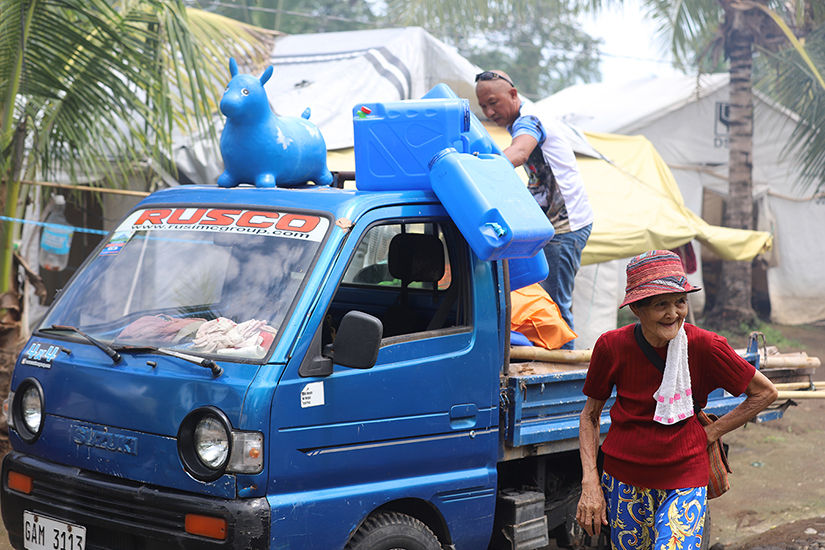
Among those eager to return to a normal life were siblings Adelina “Deling” Bilolo-Francisco, 83, and Domingo Bilolo, 69, residents of Barangay Calbayog in this town, who had endured the longest evacuation of their lives.
Albay Gov. Noel Rosal ordered the decampment of 1,132 families, or more than 4,000 individuals, from evacuation centers in Malilipot, Camalig and Guinobatan, and the cities of Ligao and Tabaco after the Philippine Institute of Volcanology and Seismology (Phivolcs) lowered Mayon’s alert status from Level 3 to Level 2 at 3 p.m. Wednesday.
“I was not able to sleep last night because of excitement,” said Deling, who had been staying with other evacuees in the tent city at Barangay San Jose for seven months.
“At least we will be able to return to our normal life at home rather than living in the tent city, which is too hot during the day,” she said.
Deling recalled that the latest evacuation was the longest she had experienced since she and her family first began fleeing Mayon eruptions in 1968, including the volcano’s powerful 1984 eruption.
She will return home carrying nine family food packs from the Department of Social Welfare and Development (DSWD) and one sack of rice provided by the provincial government.
Rosal directed the Provincial Social Welfare and Development Office to provide a sack of rice to each of the 1,131 families before they returned to their communities. Together with the DSWD food packs, the rice supply could last a family of five for about two to three months, according to evacuees.
The governor, however, reminded the returning families to strictly observe safety protocols and stay out of Mayon’s six-kilometer permanent danger zone (PDZ).
While the lowering of the alert level has allowed the evacuees to return, Mayon remains under Alert Level 2, or moderate unrest, and is still considered restless.
Phivolcs and local disaster officials warned residents near the Miisi, Bonga and Basud gullies to remain vigilant for possible lahars and sediment-laden stream flows during heavy or prolonged rains.
Pilots were likewise advised to avoid flying close to the volcano’s summit because of the potential danger from sudden ash emissions and other volcanic hazards.
Rosal directed city, municipal and barangay disaster risk reduction and management councils to remain on standby and closely monitor developments, while local governments facilitate the decampment and cleanup of the temporary shelters.
For Deling and thousands of other evacuees, however, the return home marks more than the end of seven months in evacuation.
It is a long-awaited return to the ordinary life they had been forced to leave behind.


Comments